
Designed to Sit In: The Furniture & Objects That Shape Optima’s Spaces

At Optima, design doesn’t stop at the building’s exterior. It runs all the way through, into every lobby, every residents’ club, every lounge and business center and sky deck where people arrive, pause, gather, or simply choose to stay a little longer. The furniture and objects that furnish our shared spaces are chosen with the same deliberateness as every architectural decision: for their form, their quality, their relationship to the architecture around them, and their ability to make a common area feel genuinely worth spending time in.
This is what the Forever Modern philosophy looks like in practice, not as a tagline, but as a daily commitment to placing objects of genuine design merit in the places where people actually live.
A Shared Design Lineage
Optima’s furniture curation begins with a conviction inherited from the same tradition that shaped its architecture: that the best furniture, like the best buildings, should be honest about its materials, resolved in its form, and designed to serve the person using it rather than merely impress them. That conviction leads, naturally and repeatedly, to the great names of modernist furniture design, the designers who worked at the same intersection of art, architecture, and craft that has always defined Optima’s own practice.
It’s worth understanding the historical thread. Many of the designers whose work appears in Optima communities knew each other, they taught at the same schools, competed for the same commissions, and pushed each other toward increasingly refined solutions to the same fundamental questions about how designed objects should behave in space. Florence Knoll, Charles and Ray Eames, Eero Saarinen, and Harry Bertoia all crossed paths at Cranbrook Academy of Art. Ludwig Mies van der Rohe shaped the IIT program that shaped Optima’s own founder. The furniture in our communities isn’t assembled from a catalog of prestigious names. It is an expression of a specific design lineage, one that runs from the Bauhaus through Mies, through IIT, and through every building Optima has ever built.
Pieces That Define Our Communities
The Barcelona Chair, designed by Ludwig Mies van der Rohe and Lilly Reich for the 1929 International Exposition in Barcelona, can be found at every Optima community without exception. Initially conceived as seating for Spanish royalty overseeing the opening ceremony, it was built from two chrome-plated flat steel bars on each side and leather cushion planes held together by hidden stainless buttons: a structure that is simultaneously a feat of engineering and an object of great calm beauty. Mies designed it to sit in the lobbies of his own buildings, to accent the architecture and belong to the space. At Optima Sonoran Village it holds its place in the residents’ club against the backdrop of the lushly landscaped courtyards. Optima Kierland it anchors the residents’ clubs across all five towers. At Optima Signature it occupies a building that draws its design language directly from the modernist tradition Mies built, making its presence not a gesture toward history but a genuine expression of it. That a piece designed nearly a century ago remains the right choice for a 21st-century residential community tells you something important about genuine design: it doesn’t date, it deepens.
The Eames Lounge Chair and Ottoman, first produced in 1956 and still manufactured by Herman Miller to almost the same specification, appears at every Optima community with its characteristic warmth and authority. Charles and Ray Eames spent years developing the three-dimensional molding process that would give the chair its curved plywood shell, building their Kazam! machine from bicycle parts and spare timber, pressing veneer against plaster molds with a hand-inflated membrane. The resulting chair, supple leather over molded wood, set on a six-legged base, tilted at an optimal angle, debuted on national television in 1956 and entered MoMA’s permanent collection almost immediately. The Eameses described it as having the warm, redemptive look of a well-used first baseman’s mitt. At Optima Verdana it sits in the library lounge as an invitation to the unhurried North Shore Saturday the building was designed around. Optima McDowell Mountain it offers the natural counterpoint to a community built around movement, the rooftop run finished, the cold plunge done, the chair waiting. At Optima Sonoran Village, Optima Kierland, and Optima Signature it is a daily presence in residents’ clubs and lounges: a special refuge, as the Eameses intended, from the strains of modern living.
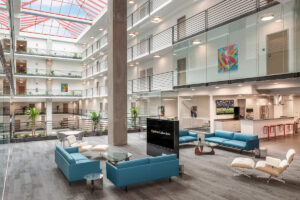
The lobby of Optima Lakeview is anchored by one of the most distinctive pieces in the entire Optima collection: the Cloverleaf Sofa by Verner Panton, designed in 1969/1970 for his Visiona 2 exhibition, a commission from Bayer AG to imagine the interior environments of the future. A snake-like configuration of four connected circular seats, its ergonomic form encourages spontaneous, multi-directional, face-to-face conversation. It is simultaneously a piece of design history, a work of art, and an extraordinarily welcoming place to sit. Against the backdrop of Optima Lakeview’s seven-story skylit atrium, with its hanging gardens and vibrant red beams, it transforms a lobby into a space worthy of a design museum, one that residents walk through every single day.
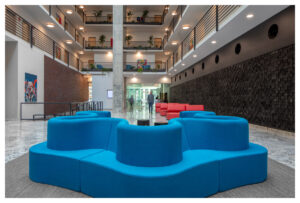
The Womb Chair by Eero Saarinen, commissioned by Florence Knoll in 1946 with the instruction that she wanted a chair she could sit in sideways, any way she liked, like a basket of pillows, appears at Optima Lakeview and across almost all Optima communities as an invitation to exactly that kind of unhurried freedom. Saarinen’s solution was a molded fiberglass shell upholstered in fabric, set on thin steel legs, wrapping around the body from every direction. It became a cultural icon upon release, appearing in a 1958 Coca-Cola campaign and on the cover of the Saturday Evening Post, and at Optima communities from Scottsdale to the North Shore it fulfills a quieter purpose: it is simply the most comfortable chair in the room.
The Tulip Table by Eero Saarinen, designed after Saarinen approached Florence Knoll in 1955 with his desire to clear what he called the slum of legs beneath every table ever made, appears in Optima Lakeview residences and throughout our communities as an elegant, weightless presence: a single white pedestal supporting a round top, the clutter of structure resolved into a single serene form. The Opera Chair by Busk+Herzog brings a contemporary voice to Optima Lakeview’s business center, high-backed and enveloping, designed for the resident who needs concentration without isolation. At Optima Kierland, the Planet and Pierce configurations serve the same purpose across the business centers of all five towers: chairs for the way people actually use common areas today, sometimes sociably, often in quiet concentration, needing just enough shelter to think.
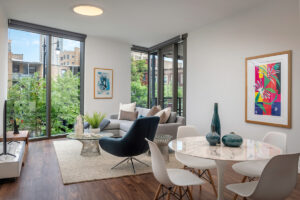
Knoll’s curated collection, whose 40-plus designs belong to MoMA’s permanent collection, provides the seating, tables, and additional pieces that ground the shared spaces at Optima Signature, Optima Verdana, Optima McDowell Mountain, and across our broader portfolio in the design tradition they deserve. The Noomi Chair appears at Optima Lakeview, Optima Verdana, Optima Signature, and other communities as a contemporary expression of the same ergonomic intelligence and material refinement that defines the classics alongside it. Together these pieces give every Optima community’s shared spaces a consistent design vocabulary, not a uniform look, but a shared quality of intention and craft that residents feel without always being able to name.
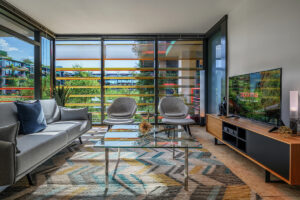
Why It Matters: Curating Authentic Modernist Design in Optima’s Shared Spaces
A common area furnished with great design is not the same as one furnished with expensive furniture. The difference lies in intention, whether pieces were chosen to impress or to serve, to fill space or to shape it. At Optima, the furniture in every shared space is part of a considered design conversation that begins with the architecture and doesn’t end until the last object is placed and the light falls across it for the first time.
The result, from Optima Sonoran Village and Optima Kierland in Old Town and North Scottsdale to Optima McDowell Mountain at the edge of the Sonoran Preserve; from Optima Lakeview and Optima Signature in Chicago to Optima Verdana on the North Shore, is shared spaces that feel genuinely alive. That have character, warmth, and a quality of attention that residents experience differently over time: the Cloverleaf Sofa in Optima Lakeview’s lobby on a grey November afternoon, the Eames Lounge Chair at Optima Verdana after a long week, the Barcelona Chair at Optima Kierland in the particular quality of a North Scottsdale morning. Great furniture, like great architecture, rewards sustained attention. At Optima, both are present in the same building, and both belong to the residents who come home to them every day.
Come experience the spaces for yourself. Schedule a tour at an Optima community today.


Latest Articles

What Living Across the Optima Portfolio Has in Common

Evenings on the Sky Deck

Optima Connect, and the Perks Worth Having